
Weekly Journal: U.S. Launches “Manhattan Project” Style Mission to Accelerate Scientific Discovery
[6 min read] Your weekend guide to getting ahead on the digital frontier. The Executive Order to plug AI into vast government datasets to speed up scientific breakthroughs.

Welcome to this week’s Weekly Journal 📔, your guide to the latest news & innovation in emerging technology, digital assets, and our exciting path to the Metaverse. This is week 155 of the 520 weeks of newsletters I have committed to, a decade of documenting our physical and digital lives converge. New subscribers are encouraged to check out the history & purpose of this newsletter as well as the archive.
- Ryan
🌐 Digital Assets Market Update
To me, the Metaverse is the convergence of physical & virtual lives. As we work, play and socialise in virtual worlds, we need virtual currencies & assets. These have now reached mainstream finance as a defined asset class:
🔥🗺️Heat map shows the 7 day change in price (red down, green up) and block size is market cap.

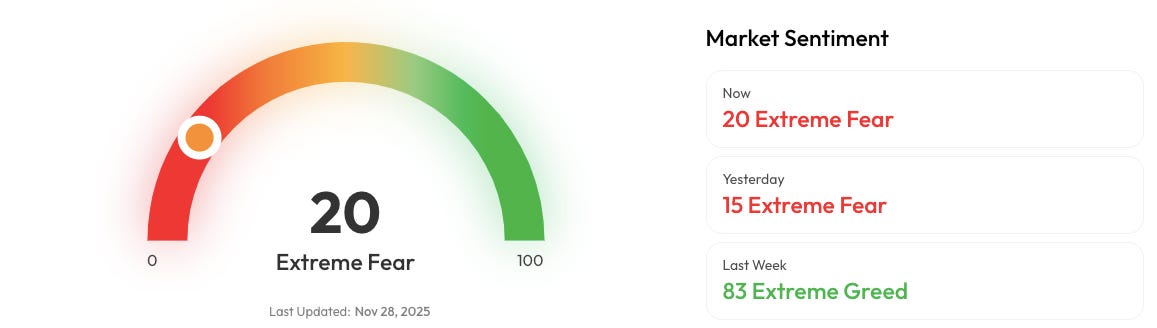
🎭 Crypto Fear and Greed Index is an insight into the underlying psychological forces that drive the market’s volatility. Sentiment reveals itself across various channels—from social media activity to Google search trends—and when analysed alongside market data, these signals provide meaningful insight into the prevailing investment climate. The Fear & Greed Index aggregates these inputs, assigning weighted value to each, and distils them into a single, unified score.
🗞️ Metaverse news from this week:
U.S. Launches “Manhattan Project” Style Mission to Accelerate Scientific Discovery
The United States has launched the Genesis Mission, a federal initiative designed to unite artificial intelligence with vast government datasets to speed up scientific breakthroughs. President Donald Trump signed the executive order on Monday, describing the effort as comparable in scale and urgency to the Manhattan Project.
The plan focuses on using AI to analyse and simulate data from agencies such as NASA, the National Institutes of Health and the Department of Energy. These datasets span the oceans, outer space, climate systems, materials science and the human genome. Officials say that AI could cut discovery timelines from years to days by automating experiment design, accelerating simulations and generating predictive models across fields such as protein folding, fusion energy, and advanced materials.
The Department of Energy has been instructed to identify twenty high-priority scientific challenges within sixty days, map its computing resources within ninety days, and demonstrate progress on at least one challenge within nine months. The mission aims to double U.S. research productivity within a decade, with AI acting as a tool to support scientists rather than replace them.
Tech giants including Nvidia, OpenAI, Microsoft, IBM, Google and AWS are listed as collaborators, though their exact roles and funding commitments remain unclear.
From a metaverse perspective, the Genesis Mission signals how national strategy is shifting toward computational infrastructure, AI-driven simulation and high-resolution digital models of physical systems. These are the same foundations required for future spatial computing, synthetic environments and digital twins, suggesting that breakthroughs here will have ripple effects across immersive technologies, scientific modelling and next-generation virtual platforms.
Marshall Islands Launches the World’s First Crypto-Based Universal Income Scheme
The Marshall Islands has introduced the first nationwide universal basic income delivered through blockchain, giving US$800 per person per year, paid quarterly. Citizens can choose to receive payments through the new USDM1 stablecoin, by cheque, or through bank deposits. The Lomalo digital wallet allows people without bank accounts to receive funds instantly, improving access across remote islands where banking services are limited.
The scheme is funded by the nation’s US$1 billion trust fund, which has grown through contributions from the United States, Taiwan and the Marshall Islands. Officials believe the UBI can be delivered without new taxes, helping stabilise household budgets and strengthening food and housing security. Despite IMF concerns about inflation and long-term fiscal risk, the government says payments will rise or fall with the trust fund’s performance and that import-driven price pressures matter far more for citizens’ daily lives.
Several Pacific nations have already approached the Marshall Islands for advice on similar digital payment systems. Researchers note that stablecoins and mobile wallets offer a practical solution for countries facing shrinking banking networks, even if few have the financial base to support a universal scheme.
From a wider technology perspective, the programme arrives at a moment when AI, automation and digital platforms are reshaping labour markets, prompting many economists to see UBI as an eventual policy response. In an emerging metaverse and a global shift toward digital economies, crypto-based money is often better suited to fast, low-cost distribution and programmable public support. The Marshall Islands has become an early pioneer in showing how that future might work in practice. Congratulations to the Marshall Islands for taking a bold and forward-looking step.
📖 Read of the week:

🎥 Watch of the week:
Leading AI economist Ajay Agrawal reveals the most critical skill for the future of work, and how mastering it will shape your role in an AI-powered world. It’s not coding. It’s not creativity. But it’s foundational for thriving in organisations being redefined by artificial intelligence.
This episode dives deep into:
How jobs are transforming in the age of AI agents
What skills actually matter as automation spreads
Why power dynamics within companies are shifting — and who will benefit
The playbook for staying relevant in a world of increasingly capable machines
Why it matters:
As AI agents become collaborators in everything from digital design to metaverse logistics, human value shifts from execution to judgement and direction. This is a must-watch for anyone shaping the future… or trying to survive it.
AI Spotlight 🎨🤖🎵✍🏼: Researchers race to teach AI irony in Marsden-funded study
In the Metaverse, AI will be critical for creating intelligent virtual environments and avatars that can understand and respond to users with human-like cognition and natural interactions.
A Marsden-funded New Zealand research project is taking on one of the most slippery parts of human communication: irony. Dr Stephen Skalicky at Victoria University is building the first deep linguistic model of irony and satire, aiming to teach AI how to recognise and eventually use the kinds of sarcastic twists that humans deploy naturally in conversation, reviews and political commentary.
Humans do this instinctively. We can tell when “This is the best” means genuine delight or total despair. AI still trips over that distinction, which matters because irony saturates social media and customer feedback. Tech companies want models that can detect tone before they misread intent or misclassify content.
Skalicky’s work dives into the language patterns, cues and contradictions that make irony work. He says defining irony is the real battle, because even humans disagree on where sincerity ends and sarcasm begins. But if AI is ever going to operate smoothly in complex social spaces, it needs to understand this layer of meaning.
Not everyone is convinced machines should go there. Comedian Tim Batt points out that irony is rooted in lived human experience, and worries about losing the uniquely human spark that comes from joking about the world together. Research like this also raises deeper questions about whether AI should be trained to inhabit emotional spaces that once belonged only to people.
Still, the stakes are real. The more AI interacts with humans across messaging apps, metaverse platforms and social feeds, the more it needs to detect tone to avoid misunderstandings. This project is one step toward closing that gap, and it’s happening right here in Aotearoa New Zealand.
That’s all for this week! If you have any organisations in mind that could benefit from keynotes about emerging technology, be sure to reach out. Public speaking is one of many services I offer.